Understanding Domestic Abuse
&
Intimate Partner Violence
Abuse can take many forms—emotional, psychological, financial, physical, or sexual. At its core, domestic abuse is about power and control. Learning to recognize these patterns is an important step toward safety, healing, and self-advocacy. If you have experienced any of these behaviors, you are not alone and it is not your fault.
What is domestic abuse or intimate partner violence?
According to the United Nation, “domestic abuse is typically manifested as a pattern of abusive behavior toward an intimate partner in a dating or family relationship, where the abuser exerts power and control over the victim. Domestic abuse can be mental, physical, economic or sexual in nature. Victims of domestic abuse may also include a child or other relative, or any other household member.”
What is emotional abuse?
Emotional abuse includes undermining a person's sense of self-worth through constant criticism; belittling one's abilities; name-calling or other verbal abuse; damaging a partner's relationship with the children; or not letting a partner see friends and family. You may be in an emotionally abusive relationship if your partner:
Calls you names, insults you or continually criticizes you.
Does not trust you and acts in a jealous or possessive manner.
Tries to isolate you from family or friends.
Monitors where you go, whom you call and with whom you spend your time.
Does not want you to work.
Controls finances or refuses to share money.
Punishes you by withholding affection.
Expects you to ask permission.
Threatens to hurt you, the children, your family or your pets.
Humiliates you in any way.
What is psychological abuse?
Psychological abuse involves causing fear by intimidation; threatening physical harm to self, partner or children; destruction of pets and property; “mind games”; or forcing isolation from friends, family, school and/or work.
What is financial or economic abuse?
Financial or economic abuse involves making or attempting to make a person financially dependent by maintaining total control over financial resources, withholding access to money, and/or forbidding attendance at school or employment.
What is physical abuse?
Physical abuse involves hurting or trying to hurt a partner by hitting, kicking, burning, grabbing, pinching, shoving, slapping, hair-pulling, biting, denying medical care or forcing alcohol and/or drug use, or using other physical force. You may be in a physically abusive relationship if your partner:
Damages property when angry (throws objects, punches walls, kicks doors, etc.).
Pushes, slaps, bites, kicks or chokes you.
Abandons you in a dangerous or unfamiliar place.
Scares you by driving recklessly.
Uses a weapon to threaten or hurt you.
Forces you to leave your home.
Traps you in your home or keeps you from leaving.
Prevents you from calling police or seeking medical attention.
Hurts your children.
Uses physical force in sexual situations.
What is sexual abuse?
Sexual abuse involves forcing a partner to take part in a sex act when the partner does not consent. You may be in a sexually abusive relationship if your partner:
Accuses you of cheating or is often jealous of your outside relationships.
Wants you to dress in a sexual way.
Insults you in sexual ways or calls you sexual names.
Has ever forced or manipulated you into having sex or performing sexual acts.
Holds you down during sex.
Demands sex when you are sick, tired or after beating you.
Hurts you with weapons or objects during sex.
Involves other people in sexual activities with you.
Ignores your feelings regarding sex.
What is stalking?
Stalking involves any pattern of behavior that serves no legitimate purpose and is intended to harass, annoy, or terrorize the victim. Typical stalking activities include repeated telephone calls, unwelcome letters or gifts by mail, surveillance at work, home and other places that the victim is known to frequent. Stalking usually escalates.
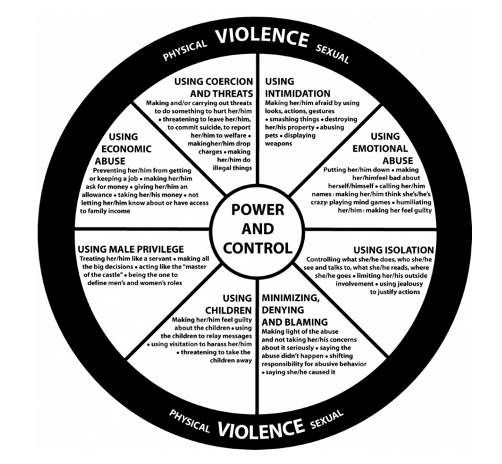
Signs to look for: Power and Control
Physical or sexual assault, or threats commit them, are the most apparent forms of domestic abuse and violence and are usually the actions that allow others to become aware of the problem. However, regular use of other abusive behaviors by the abuser, when reinforced by one or more acts of physical violence, make up a larger system of abuse. Although physical assaults may occur only once or occasionally, they instill the fear of future violent attacks and allow the abuser to take control of the victim's life and circumstances.
The power & control wheel is a particularly helpful tool in understanding the overall pattern of abusive and violent behaviors, which are used by an abuser to establish and maintain control over his/her partner or any other victim in the household. Very often, one or more violent incidents may be accompanied by an array of these other types of abuse. They are less easily identified, yet firmly establish a pattern of intimidation and control in the relationship.
(Source: developed by Domestic Abuse Intervention Project, Duluth, MN, https://www.theduluthmodel.org/)
Always remember...
No one deserves to be abused. The abuse is not your fault. You are not alone
(Source: United Nations, COVID-19 Response, https://www.un.org/en/coronavirus/what-is-domestic-abuse#:~:text=domestic%20abuse%20is%20typically%20manifested,economic%20or%20sexual%20in%20nature.)